Early access · UK limited-company year-ends
Year-end working papers, done in minutes.
Upload the Xero, QuickBooks or Sage export and the evidence. Get back a review-ready pack in your own Excel template, one exceptions list and the year-end journal. Client names never reach the model.
Works from the exports you already have
No API connection, no migration. File exports in, files out.
How it works
One job in. Three things out.
A proven trial balance for IRIS or TaxCalc, the working-paper pack with its exceptions list, and the journal back to the ledger.
- 01
Upload the exports and the evidence
TB and ledger from Xero, QuickBooks or Sage, last year's TB, and the PDFs you already chase.
- 02
Lumpsum builds and proves the pack
Code casts, maps and matches every balance to its document. The model reads and drafts, from masked data only.
- 03
You clear the exceptions and sign
A short list of what needs a person. Sign in your own Excel; the journal goes back to the ledger.
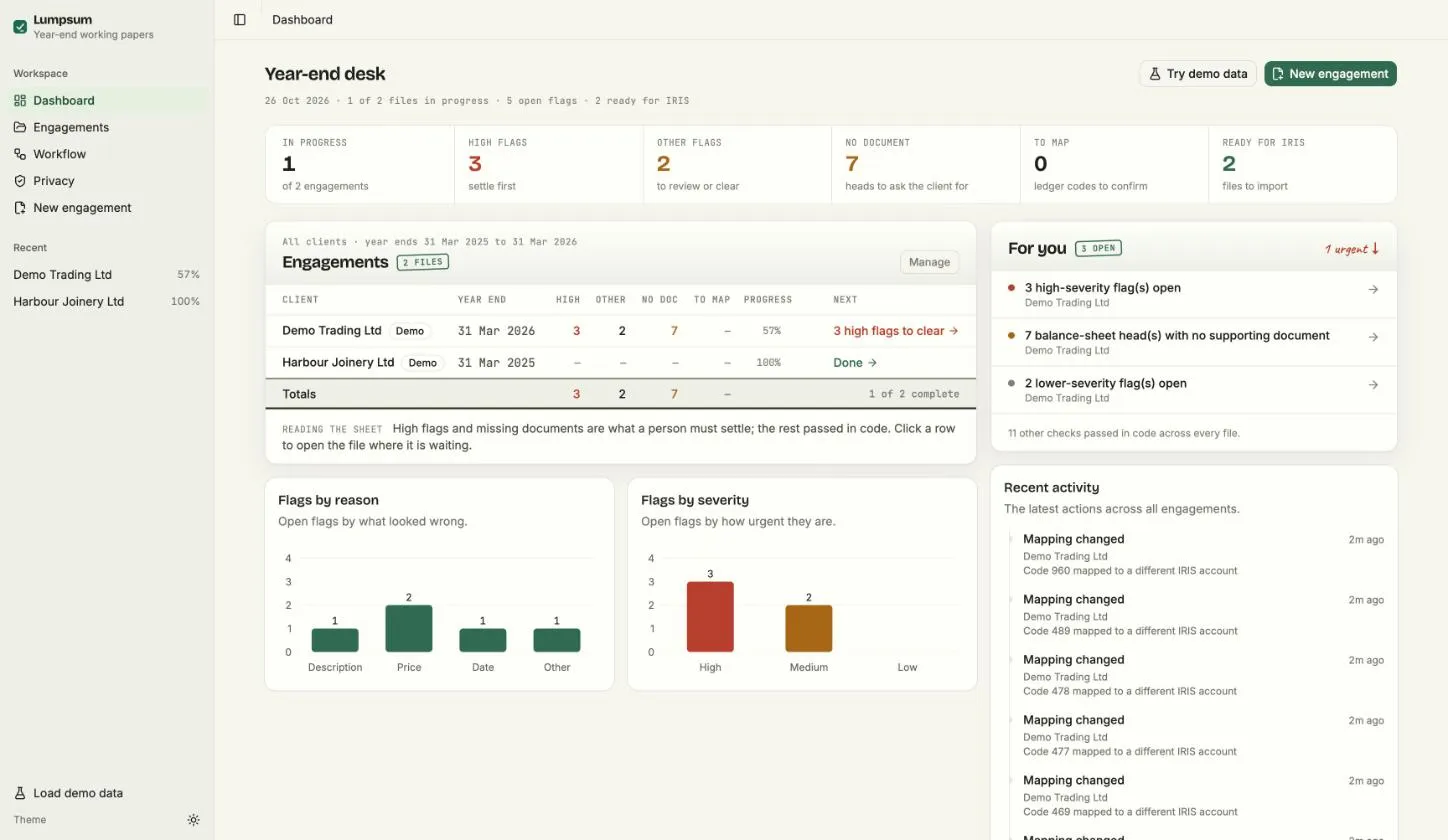
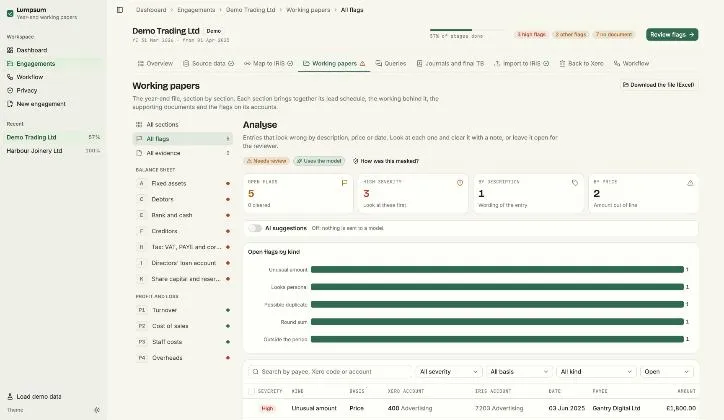
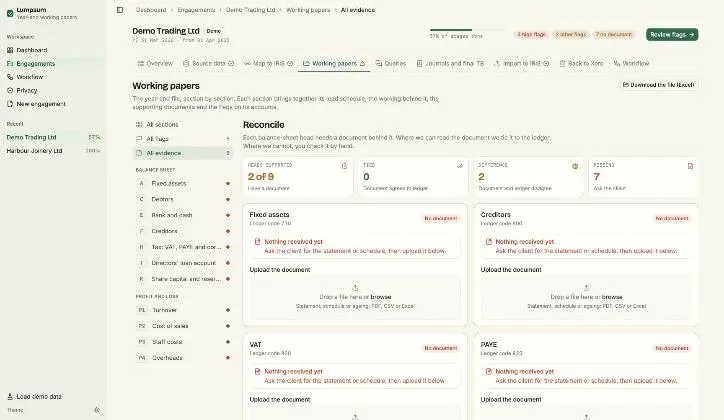
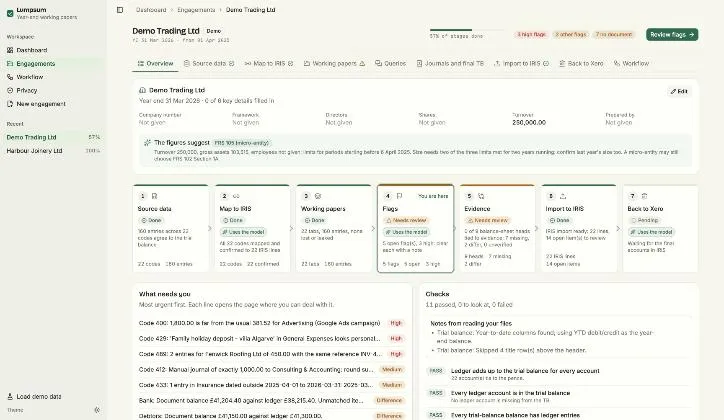
The review surface
The Excel pack is the deliverable. This is where you clear it.
A reviewer's view of each engagement: what needs a person, which checks passed in code, and a download of the pack in your template at any point.
Open the live demo sample files, nothing to install
The job today
A preparer spends the day moving numbers. A reviewer spends theirs finding what was missed.
Four to twelve hours a file, most of it re-keying and tying out. The reviewer's hours go on errors code would never make.
Data protection
The AI never knows whose books these are.
Other tools send the raw ledger to a model and promise not to keep it. Here it is architectural: tokens leave the firm, names never do.
Where it sits
Balance's business model, applied to Silverfin's customer. For the job neither touches.
The UK year-end pack for small firms is still Excel and a person. Nobody sells the finished pack to the firm that keeps the client.
| Silverfin | Balance and the AI-native firms | Offshore outsourcers | Lumpsum | |
|---|---|---|---|---|
| Sells to | Accounting firms, mid-market and top 100 | The end business | Small and mid UK practices | Small UK practices and the outsourcers that serve them |
| You buy | A platform to do the work in | A finished monthly close; they become the accountant | A person's hours, per file | A finished year-end pack, per file |
| Who keeps the client | The firm | Balance | The firm | The firm, always |
| Pricing | Per file per year, from a 50-file minimum, 12-month contract, modules on top | From £350 a month per client | Per file, 40–60% below UK cost | Per completed file, priced against the outsourcer, no licence or minimum |
| Migration | Into Silverfin templates and standard chart | Your books move to them | None | None: output lands in your own Excel |
| Client data | Lives in their cloud | Lives with them; raw ledger to the model under contract | Offshore, security varies | Masked before any model call; single-tenant; audit-logged |
From each company's published pricing and positioning, October 2026. Approximate.
Pricing
Per completed file.
Priced against what an outsourcer charges for the same pack. No licence, no seats, no minimum, no annual contract. If the pack is not usable, you do not pay.
The exact figure is being set with pilot firms.
Join the pilot waitlist- ✓Cast and checked trial balance, mapped to your lead schedules
- ✓Every balance-sheet head reconciled to its evidence
- ✓P&L variance notes drafted from the entries behind each movement
- ✓One exceptions list, signed off in your own Excel template
- ✓Mapped TB for IRIS or TaxCalc, and the journal back to the ledger
Questions
The ones partners ask first.
Does Lumpsum replace IRIS, TaxCalc or Silverfin?
No. It sits between the bookkeeping export and the accounts-production software. It produces the proven, mapped trial balance those tools start from and the working-paper pack that supports it. If you use Silverfin you probably do not need Lumpsum; most small practices do not use Silverfin.
Is client data sent to an AI model?
Only masked. Identifiers (names, account numbers, sort codes, UTRs, VAT and company numbers, postcodes, emails) are detected in code inside your environment and replaced with stable tokens. An outbound guard re-scans every payload and blocks anything that still looks like an identifier. The model never receives a client name or, by default, a real balance.
Does this breach UK GDPR or the EU AI Act?
The EU AI Act regulates use cases; matching invoices, mapping codes and drafting notes is minimal-risk and carries no high-risk obligations. UK GDPR and ICAEW/ACCA confidentiality rules do apply, and masking is what turns them from a contractual promise into an architectural fact: a data-processing agreement, training off and short retention on the model contract, plus a payload that contains no personal data. Not legal advice; the assessment is documented and available to pilot firms.
Do we have to change our working-paper template?
No. You tag your Excel template once at setup. Every pack comes out in that layout with your sign-off boxes and cross-references, and the totals are live formulas, not pasted values.
Which bookkeeping and accounts systems are supported?
Exports from Xero, QuickBooks Online and Sage are read today, including sectioned ledger reports and PDFs with a text layer. Output is an import TB for IRIS, with TaxCalc and BTCSoftware layouts to follow, and journals in Xero, QuickBooks and Sage 50 import formats.
Who signs the accounts?
You do. Lumpsum prepares; a person in the firm clears the exceptions list, edits the drafts and signs. Nothing is filed and nothing is written to a client ledger without that sign-off.
Early access
Stop paying for the hours a program should be doing.
Pilot places for UK practices and outsourcers. Bring one messy client; we will hand back the pack.